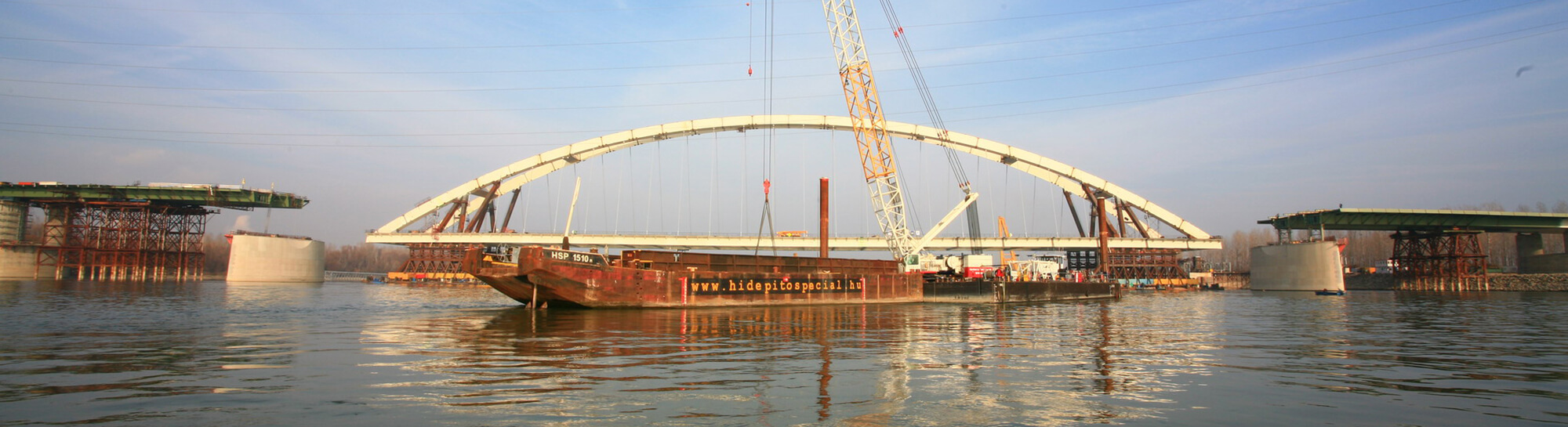
M8 Danube Bridge / Dunaújváros Bridge (Pentele Bridge) and the Construction of the Connecting Expressway, Bridge and Roadway Works, 2007
and the Construction of the Connecting Expressway, Bridge and Roadway Works, 2007
Spanning the Danube, the Pentele Bridge connects Transdanubia with the Great Hungarian Plain. The 1,682-meter-long bridge consists of three structural units: the right-bank floodplain bridge (on the Dunaújváros side) is 1,067 meters, the left-bank bridge is 300 meters, while the most significant component, the main river span—designed as a girder bridge suspended by cables from basket-handle arches—has a span length of 307.9 meters. With these dimensions, it was the world’s largest bridge of this structural design in 2007, while also taking over the title of Hungary’s largest span bridge from the Elisabeth Bridge. The bridge’s width is also extraordinary (41 m), as it is the first river bridge in Hungary capable of accommodating a full motorway width.
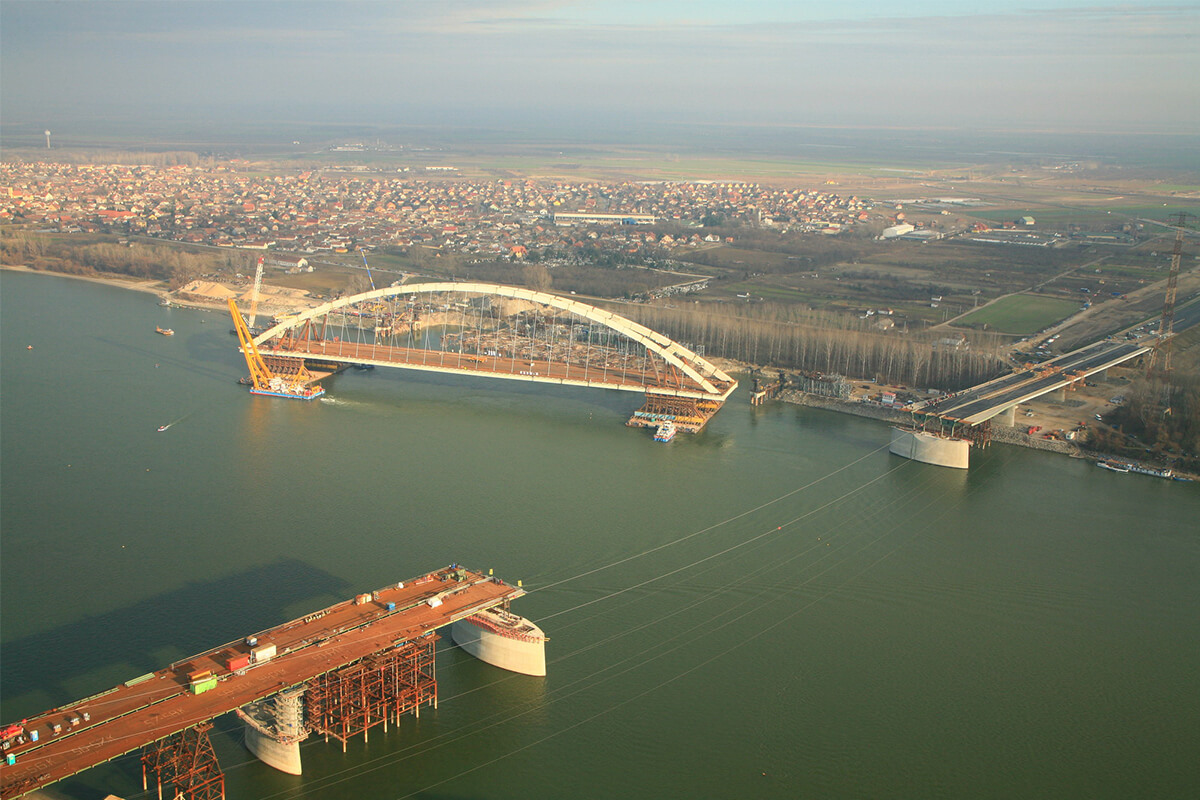
The „basket-handle” arch bridge was assembled on a staging area established on the left bank. Positioned partially over water and partially on land, we transferred it from the shore staging by dredging floating bays and utilizing 8 high-capacity barges alongside fixed falsework. The floating-in procedure consisted of several carefully planned operations. First, it was floated out of the floating bay, rotated by 90 degrees, maneuvered into alignment parallel with the bridge axis, and finally positioned onto the river piers. During the floating-in and lifting of this extremely large bridge section, additional risk factors had to be calculated, such as potential wind effects, current water levels, and the flow velocity of the Danube.
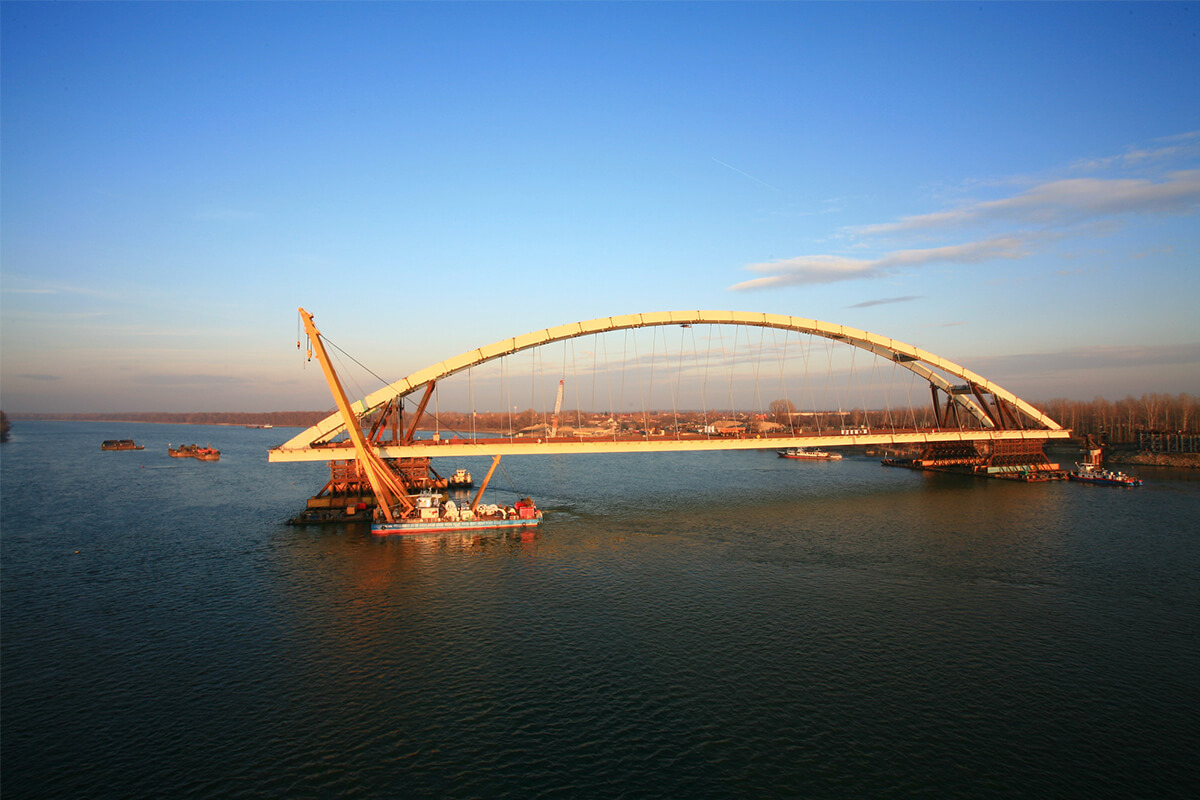
The load transfer on shore and the final placement onto the river piers along the bridge axis were assisted by a complex computer control system.
Weighing 8,650 tonnes, the main river span set a world record for the floated bridge mass on a river, practically equaling the combined mass of all previous bridge floating operations up to that time.
Based on the combined weight of the bridge and the necessary falsework (totaling approximately 10,350 tonnes), it can be stated that the load transfer, floating out of the bays, turning, floating into the actual bridge axis, and final placement onto the river piers—executed with a precision of 1–2 cm—was undoubtedly the greatest challenge and technical achievement of contemporary bridge engineering in Hungary.
In 2007, our company won the Industrial Innovation Award for its work on the „Dunaújváros Danube Bridge” and was also awarded the VINCI Central Europe Region Grand Innovation Prize.

Request a quote
If you are interested in our services and equipment and would like to plan your future projects with us, please ask for a quote.
